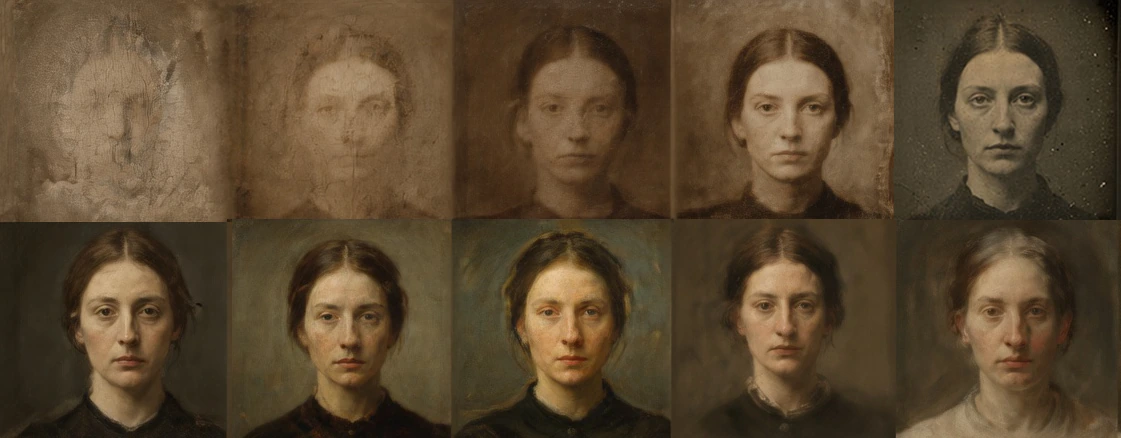
When technical perfection becomes automatic, the question of art moves away from the image as proof and toward the experience the artist can still force into existence.
I. Aisthesis and the Alien Gaze
Imagine an observer arriving on Earth with access to the entire inventory of Western art: museum halls, storage rooms, catalogues, private collections, digital archives. Now remove one piece of information from the system: chronology.
No dates. No movements. No inherited sequence of progress.
The observer begins where we believe we ended. At the surface of the archive he encounters Abstract Expressionism, CoBrA, informal painting and gestural abstraction. Paint appears as matter before image. Colour behaves like impact. The hand leaves traces of force, speed, accident and bodily pressure. Form is unstable. Space is uncertain. The image seems to come before language, before discipline, before representation has learned to control itself.
Moving further into the archive, the observer finds forms becoming more organized. Expressionism gives the figure a nervous structure. Impressionism stabilizes sensation into light. Realism gives bodies weight and rooms depth. Academic painting restores anatomy, fabric, gesture, atmosphere and social position. Further down, classical and Renaissance systems organize the body and the world through proportion, balance and perspective.
Without chronology, this sequence appears logical. It looks like the development of a species from material impulse toward technical mastery. First mud, then gesture, then light, then weight, then anatomy, then geometry.
The conclusion would be wrong. Its wrongness is useful.
It reveals how much of art history depends on the order in which we have learned to tell it. Once chronology is removed, modern art can look like a beginning rather than a late development. What we call rupture begins to resemble infancy. What we call tradition begins to resemble maturity.
The actual timeline reverses that interpretation.
Western art abandoned technical precision as the highest proof at the moment when other technologies began to take over the labour of representation. The lens could secure likeness faster than the painter. Industrial paint changed the speed and location of colour. Printing, photography, cinema, television and digital imaging distributed images beyond the studio, beyond the museum and beyond the trained hand.
Each new machine displaced part of the old artistic burden.
This changed what art had to prove.
When likeness became mechanically reliable, likeness lost part of its authority as the supreme measure of artistic value. When reproduction became industrial, uniqueness could no longer rest safely on singular manufacture. When digital tools made correction and variation almost frictionless, technical finish became less convincing as evidence of necessity.
Generative artificial intelligence is the latest and most compressed version of this historical process. It produces images and diagnoses the image culture that preceded it. It shows how much of what was recently received as style, atmosphere, virtuosity or invention can be simulated through executable pattern recognition.
This does not make art fake. It makes several inherited proofs unstable.
A beautiful image proves less when beauty is abundant. A technically impressive image proves less when technical impressiveness can be generated at scale. A recognizable style proves less when style can be treated as a vector.
The traditional escape routes are closing. Impressionist light, abstract gesture, conceptual austerity, cinematic atmosphere, documentary roughness, painterly accident: all can now be reproduced, blended and optimized. The machine does not end art by becoming creative in the human sense. It ends the comfort of confusing recognizable artistic effects with artistic necessity.
What remains is experience under pressure: the body, duration, risk, resistance, context, failure, decision and consequence.
This is why aisthesis matters again.
Esthetics, in its older sense, begins with perception, sensation and contact. Before an artwork is judged, explained or placed in a discourse, it organizes an encounter. It alters attention. It changes the temperature of a room. It slows down or accelerates the body. It produces trust, suspicion, intimacy, distance, boredom, shock or recognition.
In the age of the algorithm, the question is whether an artist can still construct an experience that resists being reduced to an image.
II. The Protocol of Bastardization
Culture scales through loss.
When isolated groups meet, they survive by building a common protocol. Gestures are simplified. Sounds are repeated. Local words are flattened into shared use. Specific meanings are sacrificed so that coordination becomes possible.
This process may look like degradation from the standpoint of a closed culture. From the standpoint of survival, it is a technical achievement.
A shared language, a clock, a decimal system, a map, a calendar, a legal category: each is a device for synchronizing reality across bodies that do not share the same immediate context. These systems reduce the world in a way that allows action.
Two people can meet at the same hour because local experience has been translated into a protocol. A price can be negotiated because value has been temporarily compressed into number. A contract can function because intention has been reduced to language. Civilization depends on these reductions.
The same structure appears in ordinary speech.
A customer in a furniture store says: “I will take the blue chair.”
The sentence seems simple. The customer and the vendor have already built a temporary field of reference. They have walked past several chairs, discussed fabric, height, colour, price, comfort and delivery. The word “chair” no longer refers to a category in general. It refers to a narrowing set of candidates inside a shared situation.
The vendor asks: “The dark blue one with the extended legs?”
The customer hesitates. “Or perhaps the grey one with the leather headrest.”
The vendor points. Another correction follows. A material is named. A colour is adjusted. A model is specified. Eventually both bodies face the same object. Meaning has been computed through rejection, specification and physical confirmation.
Human beings perform this kind of translation constantly. We do it so quickly that we mistake it for direct understanding.
Computers cannot walk with us through the showroom. They cannot point with a finger and check whether our gaze has landed on the same object. They translate through formal operations. What we call computation is, at its most basic level, the distinction of one state from another under strict conditions.
Large Language Models extend this operation into language at industrial scale. They compress vast fields of prior usage into probable continuations. They transform ambiguity into an output that can be used.
This gives them a strange cultural role.
They expose the protocol layer inside language. They show that much of what passes for difficulty is often a management of access. Academic jargon, institutional vagueness and professional obscurity frequently rely on the same mechanism: the control of terms before the public can point to the object.
The Socratic question returns mechanically: what do you actually mean?
When a complex text is reduced to ordinary language, something political happens. The authority of obscurity weakens. The private dialect of the institution is forced into a shared protocol. The blue chair is dragged back into the room.
The machine is never innocent. The protocol itself can be owned. The models, datasets, filters and interfaces can become a new priesthood. The old gatekeepers can be replaced by infrastructural gatekeepers. The power to simplify meaning is also the power to standardize it.
Still, the pressure is real. Algorithmic language systems force culture to confront a fact it often conceals: many institutions protect authority by making the act of pointing unnecessarily difficult.
III. The Kosuth Reflex: The Resentment of the Referee
Technological democratization often produces the same defensive movement. When a craft becomes more accessible, the establishment may retreat to a higher level of definition.
The printing press weakened the authority of manual copying. Photography challenged the painter’s monopoly on likeness. Industrial paint altered the discipline of colour and location. Digital tools weakened older forms of technical scarcity. Generative AI now extends that pressure across image, language, sound and style.
In each case, a familiar question appears: if the old skill can be reproduced, what still separates the artist from the technician, the amateur, the machine or the crowd?
Joseph Kosuth’s Art After Philosophy, published in 1969, belongs to this historical pattern. Its importance is undeniable. Its symptom is equally important.
Kosuth’s claim that art should be understood as an analytical proposition offered conceptual art a powerful language of legitimacy. Art no longer needed to depend on appearance, craft, beauty or sensory experience. It could operate as a statement about art itself. It could define its own conditions.
This was presented as a radical liberation. It can also be read as an institutional withdrawal.
At the moment when the older grounds of artistic authority had already been weakened by photography, mass culture, advertising, reproduction and the collapse of traditional craft hierarchies, conceptualism moved the decisive action away from the work and toward the definition of the work.
The artist became less a player inside the medium than a referee of the field.
This metaphor matters. A player acts under risk. A referee determines what counts as action. The player can fail physically, visually, materially, publicly. The referee secures authority through interpretation. He does not need to produce force. He needs to control the rules by which force is recognized.
The danger of this move is the removal of sensory consequence.
A proposition can be copied without loss. A definition can circulate without resistance. A statement about art can be reproduced by any system capable of manipulating language. Once art is reduced to analytical position, it becomes strangely compatible with the very machines that now automate language and style.
Conceptualism tried to escape the problem of technical reproducibility by moving into language. The algorithm followed it there.
This is why the Kosuth reflex matters now. Much contemporary art about artificial intelligence repeats the same withdrawal. It asks whether AI is art, who the author is, whether originality still exists, whether the machine has intention. These questions can be useful, but they are often safe. They allow the artist to stand beside the machine and discuss the field rather than enter the machine and alter its behaviour.
Andy Warhol took the opposite route.
In 1962, he placed soup cans in the gallery. The gesture was direct, vulgar, industrial and irreversible. He absorbed reproduction into the work. He forced the logic of the commodity, the advertisement and the repeated image into visibility.
Warhol entered the machine’s language and made it strange from within.
That distinction remains decisive. The artist who only asks what art is risks becoming the administrator of a shrinking territory. The artist who enters the dominant medium and changes its conditions keeps the work exposed to history.
In the algorithmic present, cultural relevance will come from constructing situations in which the machine’s smoothness breaks, where probability encounters resistance, where instant generation is forced to carry time, consequence and friction.
The task is to make the machine’s apparent inevitability unstable.